This week we open the book of Bamidbar, where God commands Moses to count the adult males—name by name, tribe by tribe. Why?
Because in Judaism, every person is sacred.
The Mishnah teaches that while we all descend from the same first human, no two of us are alike. Each of us is irreplaceable. So much so, it says, that every person should say, “The world was created for me.” Not because we are the only ones who matter—but because each life is a world.
Over the past 600 days, we’ve heard the names and stories of Israelis. But where are the stories of the tens of thousands of Palestinians who’ve been killed, injured, or displaced? Too often, Palestinian lives go unnamed and unacknowledged—rendering them invisible and suggesting that these lives, each a universe, are expendable.
This week in Cambridge, MA, concerned community members—parents, teachers, doctors, clergy, students—read the names of children killed in Gaza. For 24 hours. One by one. A sacred act of remembrance. A modern-day Bamidbar.
To see someone, to name them, is to say: You matter. You are not expendable. You are a child of the Divine.
May this week’s parsha remind us that every person is a reflection of God. And that the world was created for me, for you, for them.
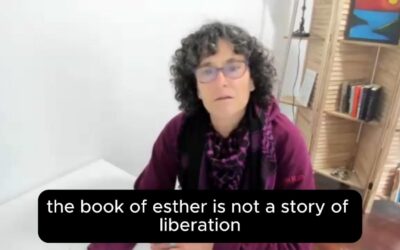
Rabbi Cat’s Musings on When the Palace Is Not Safe: Purim, Patriarchy, and the Cost of Proximity to Power
Rabbi Cat challenges the themes of Purim, contextualizing them within systems of power, complicity, and sexual exploitation.