The Ten Speech Acts & The Idolatry of Our Time | Parshat Yitro
This week in Parshat Yitro, we receive the Aseret Hadibrot—the Ten Speech Acts, more commonly known as the Ten Commandments. The revelation at Sinai is accompanied by a divine display of power, but what do these words truly mean for us today?
The first two speech acts challenge us:
🕊️ “I am Yud-Heh-Vav-Heh who brought you out of the land of Egypt, the house of bondage.”
⚖️ “You shall have no other gods besides Me. You shall not bow down to or serve them.”
How do we embody these words in our lives? The Torah teaches that the divine force is one of transformation and liberation—a power beyond material reality that calls us to break free from oppression. But human nature is fallible. The oppressed can become the oppressor. The Torah warns us that idolatry—whether of power, land, or ideology—leads to destruction. Yet, in many Jewish spaces today, questioning the existence of God is allowed, while challenging Zionism and Israel is forbidden. Have Zionism and Israel become the idols of our time? Have we forgotten the Torah’s teaching that states and ideologies exist to serve life, not the other way around?
We see the consequences:
📢 Students expelled, silenced, and threatened for speaking against injustice.
⚖️ Jewish supremacy eroding liberal values in both Israel and the U.S.
🏠 Mass expulsions proposed as “solutions,” despite our own history of exile.
Before giving the Ten Speech Acts, God reminds us: “All the earth is Mine.” Our covenant with the divine is conditional—possession of land is not absolute. When we forget this, we risk losing not only land but also our moral foundation.
So, how do we move forward?
Transformation is possible, but it requires action. As Abraham Joshua Heschel said, “God is in search of human beings.” Liberation is not a passive hope—it is a collective effort. We must stand with all those who believe in and work for justice, dignity, and the possibility of a better world.
🌍 Someday we will prevail.
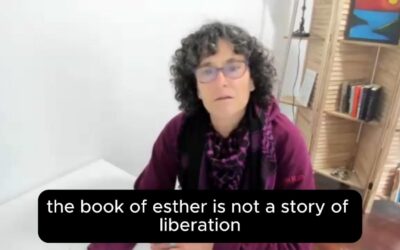
Rabbi Cat’s Musings on When the Palace Is Not Safe: Purim, Patriarchy, and the Cost of Proximity to Power
Rabbi Cat challenges the themes of Purim, contextualizing them within systems of power, complicity, and sexual exploitation.